

Choosing a career in medicine means choosing a career in exams.
Whilst we are used to exams during medical school, once postgraduate training starts it is easy to forget the techniques we use to revise, not to mention juggling life commitments!
Here are 3 simple techniques to help you make your revision efficient.
1. Active recall
Retrieving information from your brain
Why: Builds stronger memories and increases chances of long term retention
How: Avoid passive studying techniques such as reading through passages. Instead, complete practice tests and create flashcards to revise new material. Combine this with spaced repetition to enhance your learning.
Read more about this technique and how to implement it here.
2. Spaced repetition
Learning using timed intervals
Why: Your brain needs time to solidify connections. Using this method reduces the overall time needed to remember more.
How: Choose a time interval and repeat learning using this interval. The interval should double in length after each consecutive study session,
Below is the most well known timed interval (note how the interval doubles between each repetition).
First repetition: 1 day, Second repetition: 7 days, Third repetition: 16 days, Fourth repetition: 35 days
Flashcard software like Anki uses this technique to aid revision.
Below I have included time intervals suggested in Benedict Carey’s “How We Learn” which you can use to plan your revision.
Remember that all the time intervals are approximate and should be used as a guide, not a rule.
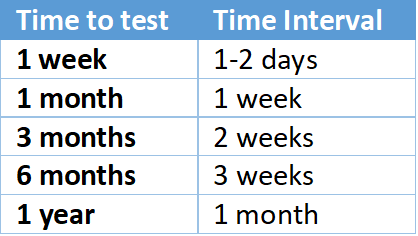
If you have an OSCE in 6 months, you should start your first repetition at 3 weeks, and double these intervals every repetition.
Like using physical flashcards?
The Leitner method is great for this. The table below can be used as a guideline.
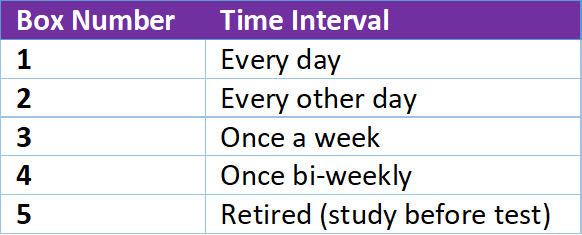
Separate flashcards into “Boxes” to help track your progress
Simply put, all information starts off in Box 1. If you can recall the information successfully, the material “graduates” to the next box. If you cannot, then the information stays in Box 1. At any point if material is not adequately recalled it moves back to Box 1.
There’s an excellent summary of this technique plus ways to automate this here.
3. The Feynman technique
Using simple language to explain concepts
Why: If you truly understand a concept you will be able to explain it simply, without jargon. Helps you to study more efficiently and pinpoint weak areas of knowledge.
How: Teaching others is an easy way to check you understand a topic. If you don’t have people around you can always use a piece of paper/record yourself and see how far you get before you get stuck. An easy way to explore your understanding is to keep asking yourself “why”.
You can read more about this technique here.
The Bottom Line
Revision is MOST effective as an activity. Using the above methods may seem longwinded, but they will help you maintain efficiency and maximise time as you approach your exam.
Remember - fail to prepare, prepare to fail!
Comment down below if you have used any of the above techniques, or if you have other techniques you use to revise!
References
Thomas Frank is an excellent writer who has vast experience with revision in a wide range of subjects. I have included links to his articles on some of these concepts below.
https://collegeinfogeek.com/spaced-repetition-memory-technique/
https://collegeinfogeek.com/feynman-technique/
Follow this link to have a look at “How we learn” by Benedict Carey https://www.amazon.co.uk/How-We-Learn-unlock-potential/dp/1447286340
https://www.brainscape.com/academy/active-recall-definition-studying/