We’ll follow the simple approach of the 5 W’s:
WHO, WHAT, WHERE, WHEN, WHY
WHO COMES?
· People who were directly involved in the event or situation
NB: This is voluntary – i.e. not everyone has to attend if they don’t wish to.
WHO LEADS aka the facilitator
Someone who was present at the event (unless nobody feels able to do so, then someone external may lead) who feels equipped with the skills to do so.
Requirement - Ideally someone who is aware of systems, culture and human factors with the following skills:
Ö Emotional intelligence
Ö Communication (active listener, non-judgmental, ability to summarise)
Ö Situational awareness
Ö Compassion
WHAT IS A HOT DEBRIEF?
Ö 5 – 15 minute team exercise
Ö Occurring as soon as possible after an event, ideally on the same shift.
WHERE?
· Confidential and safe environment. Unused theatre, staff tea room, unused office .
· Ensure no, or minimal interruptions – stick a sign up!
WHEN?
· As soon as possible on the same shift.
· Do not conduct if no safe space available or if there has been significant contention between team members that may be exacerbated by a hot debrief and lead to negative psychological effects.
WHY?
Ö It aims to generate insights into individual, team, and systemic processes, not outcomes.
o Examples include decision making, technical skills, communication, use of time and resources, leadership, and teamwork.
Ö Discussion can be used to reinforce exceptionally good teamwork and behaviours or to identify and learn from scenarios which could have gone better. They aren’t about criticism or blame!
Ö Benefits include:
· Patient:
o Increase patient quality and safety
· Individual:
o Reduces ambiguity - opportunity to seek clarity and learning on events.
o Promotes team working
o Increases job satisfaction
o Increases engagement and wellbeing and lowers stress levels
· Team:
o Increases team efficacy and function, communication, and sense of belonging
· Organisation:
o Improves safety, reporting mechanisms, and organisational effectiveness
o Opportunity to identify potential need for further support.
o Improves staff satisfaction and retention
HOW?
1. Summarise case/situation
2. Select topics for discussion
3. Identify WWW – what went well?
4. Identify EBI – even better if… what could have gone better?
5. Take homes – identify key learning and action plan.
Tools and mnemonics to help guide you…
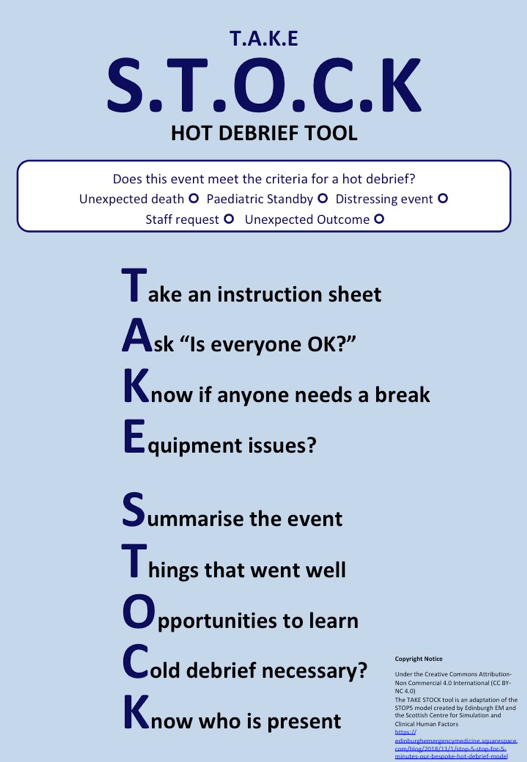
Royal college of Emergency Medicine: TAKE STOCK
ANZCA IRASTT framework:
Introduction and intention
Reactions phase
Analysis phase
Summary phase
Take home phase
Thank you phase
STOP 5 (Walker et al, 2020)
Summarise
Things that went well
Opportunities to improve
Points to action and responsibilities
Disadvantages of Hot Debriefs?
1. Infrequent and unfamiliar - therefore individuals are less prepared, especially those leading.
2. Requires a safe space
3. Lack of buy in from all team members involved
4. Significant contention between team members may make debriefing less likely to occur
5. Potential for conflict during the hot debrief
What is a cold debrief?
This is a delayed debrief, occurring days or weeks after a clinical event
Often lead on from a hot debrief.
Additional staff not directly involved with the event may also attend
Advantages:
1. Opportunity for reflection and learning on a wider scale
2. Allows more information to be collected
Disadvantages:
1. Immediate psychological safety and support is not provided.
2. Events may not be clearly remembered
3. Some participants may not be able to attend
4. Delayed learning
Take homes:
Ö Hot debriefs are gaining increasing popularity, demonstrating benefits for staff, patient care and organisations alike.
Ö Next time you’re involved with a significant incident, a hot debrief may be just what you, and your team members need…
References & further reading:
https://litfl.com/clinical-debriefing/
https://libguides.anzca.edu.au/criticalincident/hotdebrief
https://libguides.anzca.edu.au/ld.php?content_id=49791823
https://www.rcemlearning.co.uk/foamed/take-stock-hot-debrief/
